A 2-year-old child is in critical condition after being struck by a vehicle backing out of a suburban Chicago driveway, authorities said.
The incident happened Sunday afternoon in the 300 block of Grand Canyon Drive in Bolingbrook.
Police were called to the scene just before 2 p.m. for a report of a child struck by a vehicle.
Officers at the scene reported a 2-year-old victim was hit by a vehicle that was backing out of a driveway. They rendered emergency aid until paramedics arrived from the Bolingbrook Fire Department.
The child was taken to a local hospital for treatment and remained in critical condition as of Wednesday, authorities said.
McDonald’s — one of the world’s largest beef burger chains — is on a chicken journey, with a major change coming to menus permanently next month.
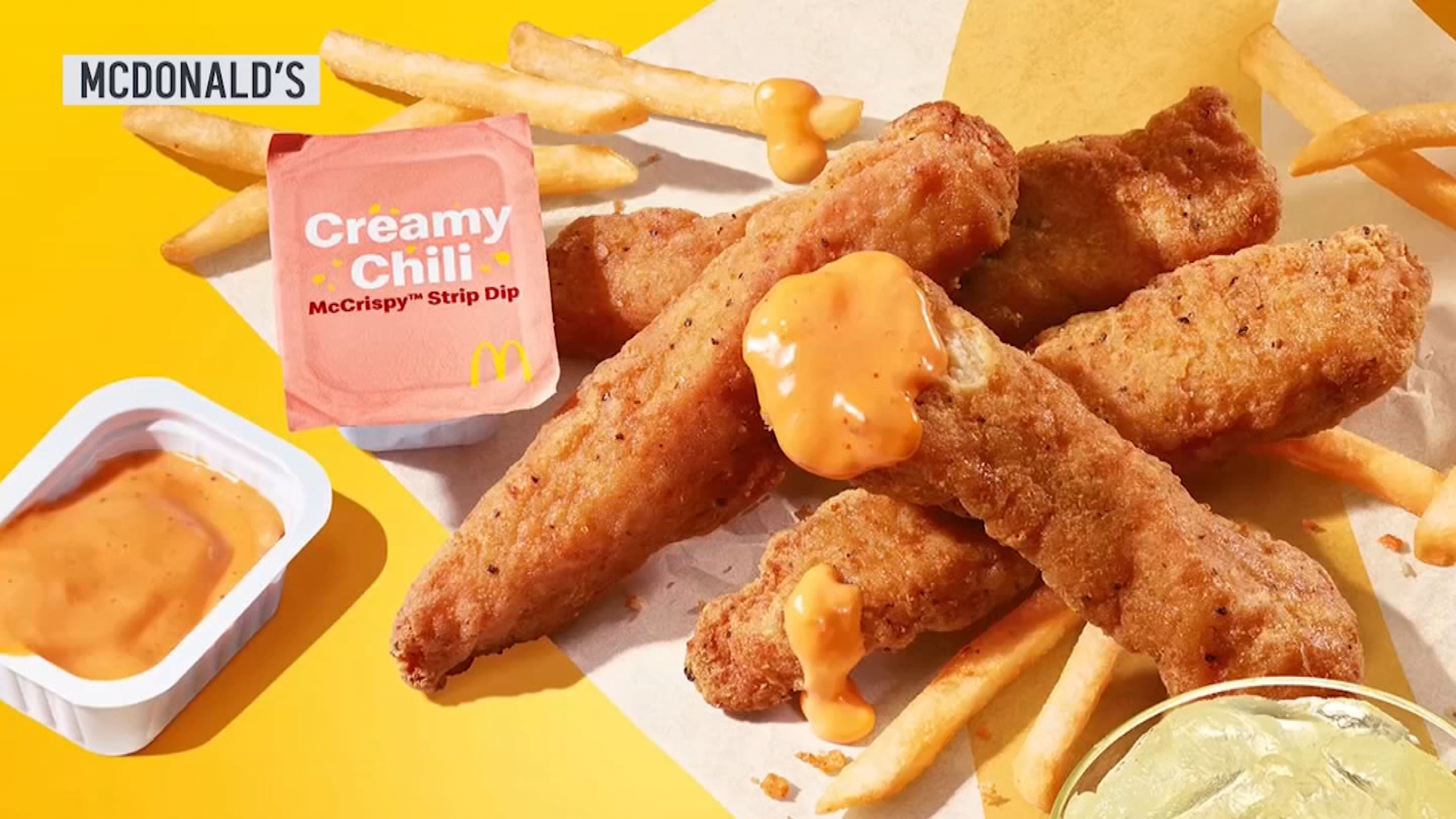
Beginning next month, McDonald’s will debut new McCrispy Strips, along with a new Creamy Chili Dip, to menus nationwide. The chicken strips, made with 100% white meat, and the “savory, sweet and tangy sauce” mark the first time since 2021 McDonald’s has made menu changes that aren’t just temporary.
Chicken at McDonald’s dates back to the 1980s, with the launch of the tried-and-true McNugget. In more recent years, the brand has doubled down on adding big chicken hits to menus, including the Chicken Big Mac last fall, and the forthcoming return of the fan-favorite snack wrap later this year.
But the Chicago-based burger brand has had some chicken misses, too. In 2020, the brand introduced Spicy Chicken McNuggets, but the items didn’t last. Before that, in 2004, McDonald’s entered the chicken finger game, with thick and crunchy Premium Chicken Selects. Those lasted on menus for nearly 10 years.
In 2017, the chain added a similar item called Buttermilk Crispy Tenders, but those were discontinued in during the COVID pandemic in 2020, reports said.
That same year, the idea for the next chicken product was hatching, Chef Charles of McDonald’s said at a press event Tuesday. But, according to customer feedback, the this one needed to be less crispy.
“What we had learned from our customers, our fans, is that, you know, it used to be 20 years ago, everybody wanted a real crunchy…they wanted a lot of breading on their chicken,” he said. “What we found out, as time goes on, we don’t that that. We want a softer bite. We want a crispy chicken, but we don’t want as much breading on it.”
Chef Charles went on to say that McDonald’s worked with suppliers on the cut of the new chicken strip, to help it stay more juicy and tender. The breading on the strip is simple, he said, with a flour-based, salt-and-pepper system. That’s different than the tempura-battered McNugget, or Chicken Big Mac, he said.
When the taste test came, the strips — of various shapes — looked much like a seasoned chicken tender, but softer and thinner, though still dense. The breading on the long strips were even, unlike other types of tenders that have gobs of batter on one side or another.
“Definitely a bit of a crunch, can you hear it?” NBC Chicago video producer Gabi Rodriguez said, after biting into the bird. “She’s juicy, dare I say.”
When ripping a strip apart, the white meat held together solidly. No strings, no hidden dark meat – just half a strip, ready to dip.
And that’s where the sauce — the new Creamy Chili Dip — comes in.
“Definitely creamy,” NBC Chicago Producer Francie Swidler said. “Has a kick, has a bite.”
The spice-filled dip and strip paired well, but another sauce came out on top as well when drizzled on the chicken: McDonald’s classic Honey cup (not to be confused with Honey Mustard).
“Skip the Honey Mustard, go straight to the honey,” Swidler said.
It turns out though, the best combination was a strip dipped in honey first, and then creamy chili dip.
“My favorite,” Rodriguez said. “That was my favorite dip combo.”
According to McDonald’s, the strips and dip came after “countless taste tests,” and listening to customers.
“We took our time, listened to our fans and created a product we knew they would crave.” Alyssa Buetikofer, Chief Marketing and Customer Experience Officer at McDonald’s said in a release introducing the new items. “And the best part is we’re just getting started.”
McCrispy Strips, which come in three or four-piece counts, along with the Creamy Chili Dip, will be available beginning May 5 at McDonald’s restaurants nationwide.
Bob Ross inspired thousands to pick up their palettes and paintbrushes during his career, and now a huge exhibit will pay tribute to his work.
According to the Wall Street Journal, a new exhibition will feature dozens of Ross’ landscape paintings, and is expected to open either in late 2025 or early 2026 at the Minnetrista Museum & Gardens in Muncie, Indiana.
The museum, located approximately 50 miles to the northeast of Indianapolis, already features plenty of tributes to Ross, restoring his iconic television studio and helping to offer classes to those seeking to learn the artist’s techniques.
According to the report, the newly expanded exhibit will feature works which were painted on the iconic PBS show “The Joy of Painting,” which rain from 1983 to 1994.
Among the works included will be “The Wilderness Way,” which was the last painting Ross created for the program before his 1995 death.
For those who don’t want to wait until later this year to see tributes to Ross, they can visit the museum’s “Bob Ross Experience.” The exhibition features the opportunity to visit the restored television studio where Ross filmed “The Joy of Painting,” along with a recreated 1980s living room, designed to evoke the space where the artist’s thousands of fans discovered his work for the first time.
Ross’ work has enjoyed a renaissance of sorts in recent years, with his image adorning a wide variety of merchandise and his artistic philosophy inspiring thousands. A weekend-long feed of “The Joy of Painting” is available on the Twitch platform, with a portion of the advertising proceeds going to charity, according to the website.
Ross was a proponent of the “wet-on-wet” technique, painting images over a thin base layer of wet paint. He would break down the process into simple steps with the idea of viewers creating their own artwork along with him on a daily basis.
After more than a decade on the air, Ross passed away in 1995 due to complications from lymphoma.
You may assume if you buy a child’s product from a store shelf it’s going to be safe. But NBC 5 Responds found that’s not always the case.
NBC Chicago started looking into this topic when a member of our consumer investigative team, NBC 5 Responds, noticed an item on the shelf of a Wilmette Walgreens store. Gerber’s Sooth ‘N Chew Teething Sticks were voluntarily recalled by Gerber in January, because the company says, they pose a choking risk. But the teething sticks were still available for sale in Walgreens’ baby section in March.
NBC 5 Responds bought the last box of the teething sticks and reported the issue to Walgreens Management. NBC Chicago also found the item for sale online at Jewel Osco grocery stores.
Walgreens told NBC 5 Responds it works with suppliers and distribution centers to collect recalled products from stores and consumers, and it’s reviewing the process with store staff to ensure no recalled items are mistakenly purchased.
Jewel Osco said it removed the voluntarily recalled products from its website after NBC 5 Responds brought this to its attention.
It’s Illegal to Sell Recalled Items
Gabe Knight, a senior policy analyst at Consumer Reports, says it’s illegal for a company to sell a recalled product.
Knight explained it falls on product manufacturers to report recalls to retailers. Then, the retailer must act immediately to remove the recalled item before a consumer can buy it.
Online, it’s even easier to come across recalled children’s products. Making matters worse, you may not realize a product was recalled in the first place. Knight explained that it’s a cumbersome and expensive process for the Consumer Product Safety Commission to force a company to conduct a recall.
“Usually, it’s a voluntary process,” said Knight.
If a company doesn’t issue a voluntary recall, the CPSC will issue a public safety warning. However, the product will still likely be available to the public.
NBC 5 Responds Gets Recalled Toys Removed from Online Marketplaces
NBC5 Responds found a sensory board for babies and toddlers available for sale online. The CPSC said the board could pose a choking hazard for small children.
The Vietnamese toy manufacturer never responded to the agency’s request to issue a voluntary recall, prompting the CPSC to issue a public safety warning in October. But in May, NBC 5 Responds found the toy still for sale on Amazon.
When we brought this to Amazon’s attention, Amazon told NBC Chicago it was never contacted about the dangerous toy and said it took down the listing after we brought this to its attention.
Why Do Recalled Items Keep Appearing in Stores and Online?
Our partners at Consumer Reports believe recalled toys and foods keep popping up in stores and online marketplaces because of the seemingly small civil penalties the CPSC is allowed to levy on companies.
Each violation could cost a company up to $100,000, according to the Consumer Product Safety Commission. But Consumer Reports says that’s not always enough to force compliance.
Russian forces continue to batter Ukraine, devastating civilian areas. Ukrainian troops have mustered a resistance against the odds, though President Volodymyr Zelenskyy is on edge as his resources grow perilously thin. Meanwhile, Trump has suggested a deal is in the works while also expressing skepticism that any agreement will be reached soon.
“We have the confines of a deal, I believe,” Trump told reporters on Sunday, saying he wanted Russian President Vladimir Putin to “sign it and be done with it and just go back to life.”
Trump, of late, shifted blame back and forth between the two leaders, lashing out at Zelenskyy for “prolonging” the “killing field,” and then blasting Putin for complicating negotiations with strikes on Ukraine late last week that were “very bad timing.”
As Trump struggles to resolve a complicated geopolitical crisis that started more than three years ago with Putin’s brazen full-scale invasion of Ukraine, he has admitted he’s been frustrated by the negotiations — and now says that his promise of an immediate end to the conflict was an “exaggeration” made in “jest.”
Trump on Friday proclaimed that Ukraine and Russia were “very close to a deal” after his special envoy, Steve Witkoff, met with Putin in Moscow. But he struck a more hesitant tone Saturday after huddling with Zelenskyy at the Vatican amid Pope Francis’ funeral, their first meeting since a stunning Oval Office shouting match in late February that led the White House to briefly pause U.S. military assistance.
The two leaders sat in a large, mostly empty room at the Vatican, their armchairs pulled in close as they leaned toward each other and spoke intently.
In a Truth Social post after their meeting, Trump described the Ukraine conflict as a “mess that was left to me by Obama and Biden, and what a mess it is.”
“There was no reason for Putin to be shooting missiles into civilian areas, cities and towns, over the last few days. It makes me think that maybe he doesn’t want to stop the war, he’s just tapping me along,” Trump wrote, hinting economic sanctions could follow.
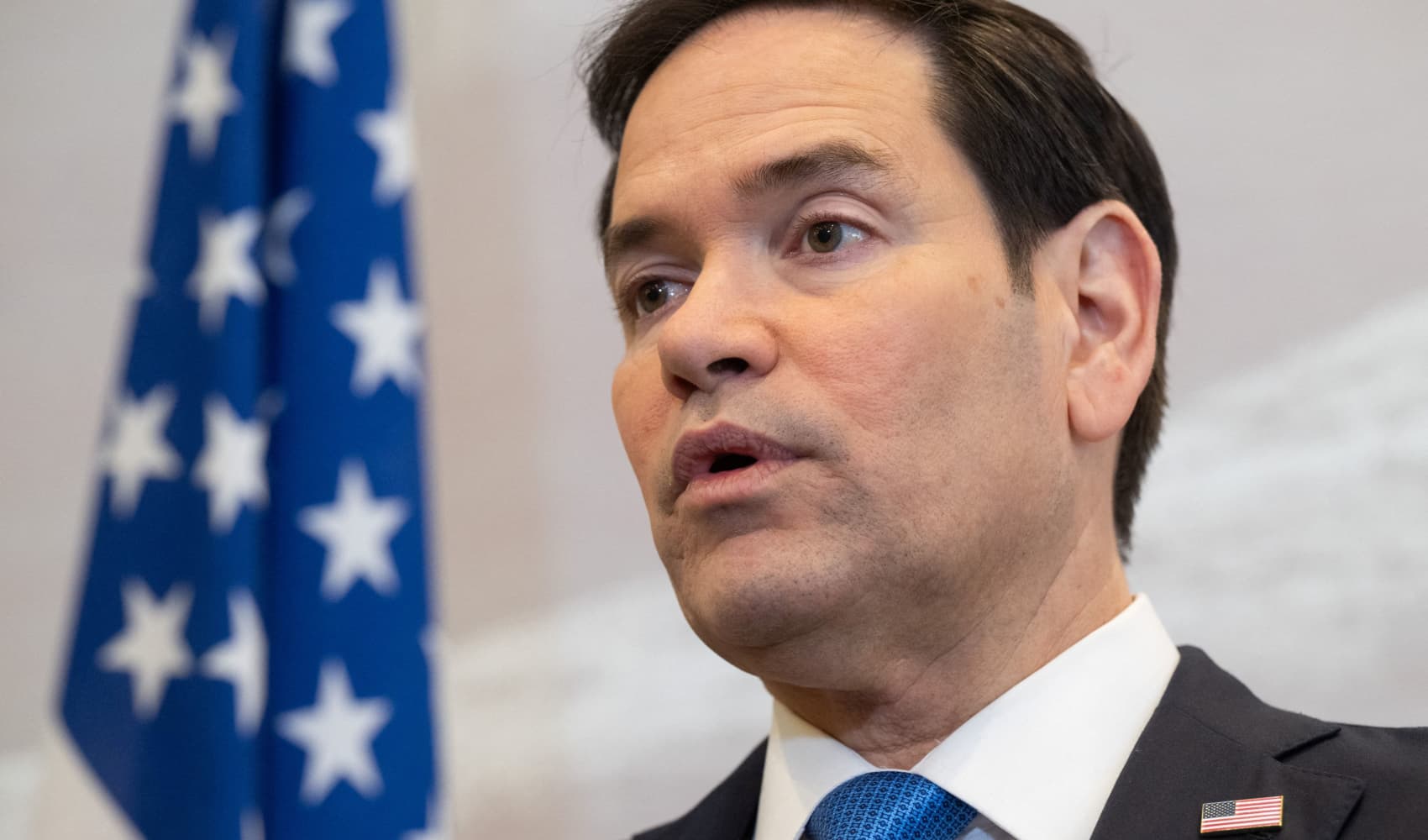
Secretary of State Marco Rubio, for his part, warned earlier this month that the White House was prepared to “move on” and walk away from talks if Ukraine and Russia did not make significant progress toward ending the conflict.
Zelenskyy has rejected some of the possible concessions, including Trump’s statement in Time magazine that “Crimea will stay with Russia,” referring to the strategic peninsula that Putin illegally annexed in 2014.
Trump’s efforts on Ukraine come as he rapidly remakes the international order on other key fronts. He has launched a sweeping trade war with China, gutted U.S. aid to the developing world and repeatedly mused about acquiring both Greenland and Canada.
He has so far failed to permanently stop another conflict raging in the Middle East. After he helped broker a temporary ceasefire between Israel and Hamas, that fragile peace fell apart and fighting has resumed.
In an interview with The Atlantic published Monday, Trump said: “I’m trying to save a lot of lives in the world. You know, Ukraine and Russia — it’s not our lives, but it could end up in a Third World War.”
The president, who has long admired what he views as Putin’s strength and advocated for closer ties between the U.S. and Russia, went into his second presidency seeking to shift decades of U.S. foreign policy and bipartisan hawkishness on Russia. Republicans are increasingly behind Trump, as the MAGA political coalition sours on interventionism and views U.S. support for Kyiv as a waste of taxpayer dollars.
Trump’s predecessor, Joe Biden, framed Russia’s invasion of Ukraine in stark moral terms and attempted to rally the U.S. behind Kyiv. Trump’s approach has been far more transactional, with a focus on payback for American support in the form of a proposed deal giving U.S. access to Ukraine’s rare-earth minerals.
Trump has adopted some of Putin’s falsehoods about the war, including the idea that Ukraine started the conflict. In their tense Oval Office meeting, Trump and Vice President JD Vance castigated Zelenskyy in front of television cameras, thrilling American populists who favor a sharp turn away from internationalism.
Yet as the conflict rages on, Trump has also increasingly publicly chastised Putin. He posted on Truth Social last week that he was “not happy” with Russia’s strikes on Kyiv and made a direct appeal to Putin: “Vladimir, STOP! 5000 soldiers a week are dying. Lets get the Peace Deal DONE!”
The two sides are at an impasse on other crucial issues. Zelenskyy has sought entrance into NATO, which would bring Ukraine into a mutual defense pact with other Western powers. Russia staunchly opposes that bid, characterizing it as a provocation from a nation it barely considers legitimate. Trump has so far been largely unsupportive of Ukraine joining NATO.
In the same Time magazine interview, Trump appeared to chafe at the idea that he was running behind schedule on securing peace in Eastern Europe, saying in part: “The war has been raging for three years. I just got here, and you say, ‘What’s taken so long?’” He made similar remarks about the war between Israel and Hamas.
In a statement to The Associated Press, White House National Security Council spokesperson James Hewitt said Trump is still committed to getting a Russia-Ukraine deal completed and is “closer to that objective than at any point during Joe Biden’s presidency.”
“Within 100 days, President Trump has gotten both Ukraine and Russia to the negotiating table with the aim to bring this horrific war to a peaceful resolution,” Hewitt said. “It is no longer a question of if this war will end but when.”
On Monday, Putin announced a brief ceasefire, starting at midnight local time May 8 and ending at midnight May 11, to coincide with Russia’s celebration of its triumph over the Nazis in World War II. (Putin has likened Ukraine’s government to Nazi Germany.)
Ukrainian Foreign Affairs Minister Andrii Sybiha responded to the announcement by calling on Russia to “cease fire immediately” if it “truly wants peace.”
“Why wait until May 8th?” Sybiha asked Monday in a post on X.
This story first appeared on NBCNews.com. More from NBC News:
It’s been nearly a decade since Kim Kardashian was robbed at gunpoint in her luxury Paris hotel.
In 2016, the reality star was tied and gagged as a group of thieves made away with millions worth of jewelry, an experience Kardashian described as “horrific.”
Now, 10 suspects that prosecutors have linked to the incident are going to trial. Nine men and one woman will stand trial in Paris for the sensational robbery, and Kardashian herself is set to give in-person testimony on May 13.
Kardashian, 44, was physically unharmed in the incident, but she has opened up about how the experience “shook” her and changed her perspective on life, as she shared in a recent episode of Hulu’s “The Kardashians.”
Keep reading to learn more about the Paris robbery, and the details of the upcoming trial in Paris.
When did the robbery take place?Kardashian was robbed at the Hôtel de Pourtalès in Paris, France, in the early hours of Oct. 3, 2016.
She had been in France for Paris Fashion Week and had just attended a Givenchy fashion show on Oct. 2.
Five people dressed as police officers overpowered the hotel’s night watchman and accessed her room, a judicial source told NBC News at the time.
Kardashian was then bound and held at gunpoint by two masked men, according to NBC News.
A spokesperson said Kardashian was left “badly shaken but physically unharmed” after the incident, according to NBC News.
What was stolen?
Thieves stole millions worth of jewelry from Kardashian, including the diamond engagement ring from her ex-husband, Ye, then known as Kanye West.
One of the robbers fell from his bike, dropping a bag. A single item was recovered by police.
In January 2017, authorities arrested 14 men and three women across five French cities in connection with the robbery, according to NBC News.
Some of those suspects were subsequently released from suspicion. Suspect Marceau Baum-Gertner died before the trial at 72, and another suspect, Pierre Bouianere, 80, will be tried separately due to health reasons.
Ultimately, 10 suspects will stand trial in the upcoming court proceedings in Paris. The suspects have been nicknamed the “Grandpa Robbers” by the French media because many of them were men in their 60s and 70s.
The charges they face include kidnapping, armed robbery in an organized gang and unauthorized possession of weapons, according to information provided to reporters by the Paris Court of Appeal.
One of the suspects is Aomar Ait Khadache, who has denied allegations that he was the ringleader of the heist.
Another suspect awaiting trial, Yunice Abbas, wrote about the heist in a 2021 tell-all book called “I Kidnapped Kim Kardashian.”
He was also candid about his role in the heist in a 2022 Vice News interview, detailing how he and his accomplices carried out the robbery.
“I went on the internet and it’s true, I saw her jewelry, I saw her ring, I saw that she showed it everywhere,” he said.
He admitted he and his team overpowered the concierge at Kardashian’s luxury hotel, and said that in the course of tying up the receptionist, he left DNA that linked him to the crime.
“As I already had a record, it was very easy to trace me,” he said.
He also said he had watched an episode of “Keeping Up With the Kardashians” in which the reality star throws a diamond into a swimming pool.
“I thought, ‘She’s got a lot of money. This lady doesn’t care at all,’” he told Vice.
He added that he did not feel any guilt about the incident.
“Since she was throwing money away, I was there to collect it, and that was that. Guilty? No, I don’t care. I don’t care,” he said.
Asked whether it had occurred to him that Kardashian could be “traumatized” by the robbery, Abbas said there was “no doubt.”
“Yes, of course. You don’t come out of it unscathed … of course, she must have been traumatized,” he said.
In an interview with France’s TF1 released in 2025, Abbas said, per a translation from NBC News, “I see her as a victim, nothing more. We had nothing against her personally. It’s just business. I’m sorry we scared that lady, because I can imagine it’s not easy for the victim. I really regret what happened.”
What has Kim Kardashian said about the heist?
Kardashian has opened up about the lasting trauma she experienced from the robbery.
She recounted the details of the harrowing experience during a March 2017 episode of “Keeping Up With the Kardashians.”
“They asked for money,” Kardashian said in the episode. “I said I don’t have any money. They dragged me out to the hallway on top of the stairs. That’s when I saw the gun, like, clear as day.”
She said she had to decide in a “split second” what to do next.
“Am I going to run down the stairs and either be shot in the back or …? It makes me so upset to even think about it,” she said through tears. “Either they’re gonna shoot me in the back, or if they don’t and I make it … or if the elevator does not open in time or the stairs are locked, then like, I’m f—-d.”
In a 2020 interview with David Letterman on his Netflix show, “My Next Guest Needs No Introduction,” she also said she feared one of the robbers would rape her.
“He grabbed me and pulled me towards him, but I wasn’t wearing anything underneath so I was like, ‘OK, this is the time I’m going to get raped. Just deal. It’s going to happen. You know, just prepare yourself,’” she said.
“So I did … but then he tied me up with handcuffs and then zip ties, and then duct tape, and then duct taped my mouth and my eyes,” she continued. “And before he had my eyes … I saw he found my whole jewelry box.”
The reality star has also opened up about how the experience changed her.
“For a good year, I almost lost myself,” she said on “The Alec Baldwin Show” in 2018, per E! News. “I was never depressed, but I wasn’t motivated to get up and work like I used to. It shook me.”
She added that ultimately, the attack gave her a new outlook on life and said she was “grateful” for the experience, even though it was “horrific.”
“There was a lot of me that measured who I was by how much I had. I thought, ‘Oh, I’m worth so much,’” she said. “That needed to change in me.”
Kardashian also said she grew more cautious about posting on social media following the incident, being sure not to reveal her live location in posts.
“If I want to video something, I’ll save it and post it when I leave,” she said.
During a 2023 episode of “The Kardashians,” she said he hadn’t bought new jewelry since the robbery.
What’s going on with the trial?
Ten suspects will stand trial for the heist beginning April 28, 2025, in the Paris Court of Appeal.
The trial, which includes six main jurors, is expected to end with a verdict on May 23.
No photography will be permitted in court, according to information provided to the press by the Court of Appeal.
Kardashian confirmed through her lawyer, Michael Rhodes, that she will testify in person on May 13.
“We can confirm that Ms. Kardashian will be testifying in person at the upcoming French criminal trial involving the 2016 incident in which she was bound and robbed at gunpoint by a number of masked assailants,” Rhodes said in a statement obtained by NBC News.
“At this time, Ms. Kardashian is preserving her testimony for the Court and jury and does not wish to elaborate further on it at this stage,” the statement continued. “She has tremendous appreciation and admiration for the French judicial system and has been treated with great respect by the French authorities.
“She wishes for the trial to proceed in an orderly fashion in accordance with French law and with respect for all parties to the case,” the statement concluded.
This story first appeared on TODAY.com. More from TODAY:
A shooting in the popular South Carolina tourist town of Myrtle Beach left 11 people wounded, and police fatally shot one person, authorities said.
Myrtle Beach officers responded to a disturbance involving multiple individuals Saturday night in which someone began firing a weapon. In a statement, the department said that “based on the immediate threat,” an officer then shot one person, who died from their injuries.
The person’s name wasn’t immediately released, and it wasn’t clear whether they were a suspect. A telephone message left with Myrtle Beach police was referred to the South Carolina Law Enforcement Division, which didn’t immediately return an email Sunday.
The department said 11 people who sustained injuries were receiving medical treatment.
The Chicago Cubs have recalled pitcher Tom Cosgrove from Triple-A Iowa and optioned Ethan Roberts to the minor leagues.
Cosgrove was acquired by the Cubs on April 10 in exchange for cash considerations. He was assigned to Triple-A Iowa, and has made three consecutive scoreless appearances for the club, with seven strikeouts in four innings.
In his MLB career, Cosgrove has made 72 appearances, with a 3.95 ERA and 59 strikeouts in 66 innings.
Roberts has made nine appearances for the Cubs this season, with an 8.22 ERA in 7.2 innings. He was roughed up for four earned runs, including a home run, during Saturday’s loss to the Philadelphia Phillies.
In parts of three seasons with the Cubs, Roberts has a 4.85 ERA in 32 appearances, sporting a 2-2 record and striking out 41 batters in 42.2 innings.
The Cubs will face the Phillies again Sunday night in the rubber match of their three-game series at Wrigley Field. The Cubs enter action Sunday with a 2.5-game lead on the National League Central, but still have not played a game against a divisional opponent.
That run will end on Tuesday when they head to Pittsburgh to take on the Pirates, the start of a six-game road trip that will also bring them to Milwaukee for a showdown with the Brewers.
According to Pritzker’s order, flags will be flown at half-staff until Tuesday at sunset in Meyer’s memory. Meyer will be laid to rest after a funeral service Tuesday, according to the Chicago Fire Department.
Meyer died Wednesday when a structural collapse occurred in the garage in the 5500 block of West Crystal Street. A mayday call went out at approximately 5:40 a.m., and Meyer was rushed to a nearby hospital, where he was pronounced dead.
Meyer was a 28-year veteran of the department, and was survived by his wife, three daughters and a son.
The fire was determined to have been deliberately set, and a suspect has been arrested and charged with murder and aggravated arson in connection with the blaze. He is accused of deliberately setting the contents of a trash can on fire, one of several blazes that was reported in the area in the days prior to the fire that led to Meyer’s death.
The suspect was ordered held pretrial by a judge this weekend.
The 2025 NFL Draft in Green Bay has come and gone, and the Chicago Bears made several big additions to their roster.
The Bears came into the NFL Draft with seven picks, but they ultimately were able to make eight picks after multiple trades throughout the process, addressing needs on both sides of the ball.
Through those trades, the Bears ended up with three picks in the second round, and they added five offensive players and three defensive players by the time all was said and done.
Here is a full list of all eight of the picks, as well as quick bios of each player.
Round 1, Pick 10: Tight end Colston Loveland, Michigan
Loveland was ranked as one of the top two tight ends in the draft along with Penn State’s Tyler Warren, but it was the Michigan product that was the first player taken in this year’s draft.
Loveland had 56 catches in the 2024 season, a record for a tight end playing for the Wolverines, and added five touchdowns and 582 receiving yards for good measure. He is expected to line up all over the field for the Bears, as he can run a variety of routes, causing matchup issues for opposing defenses.
Round 2, Pick 7: Wide receiver Luther Burden III, Missouri
Burden gives the Bears another receiving option with the departure of Keenan Allen, racking up 61 catches for 676 yards and six touchdowns last season for Missouri.
Burden was first-team All-SEC in his final season with the Tigers, and was a second-team All-American in the 2023 campaign. He became well-known for his ability to rack up yards after catches, and could be a useful player for the Bears as a slot receiver threat, though he can line up outside too.
Round 2, Pick 24: Offensive tackle Ozzy Trapilo, Boston College
Trapilo was an All-ACC right tackle for Boston College, having started his collegiate career at left tackle before moving to the other side of the line for the 2023 season.
The NFL’s scouting profile of Turner flags his penchant for picking up costly penalties due to lack of discipline, but raves about his relentless style and his willingness to play with a “heavy dose of violence” to go along with quick first steps and his ability to hit blockers hard at the line.
He also fits into a variety of pass rush styles, but has to work on getting to the quarterback faster at the next level.
Round 4, Pick 30: Linebacker Ruben Hyppolite III, Maryland
Hyppolite is a speedy linebacker that could earn playing time at the Will spot for the Bears, with 66 combined tackles and seven tackles for loss in his final season with the Terrapins.
He’s viewed as an athletic player who needs to work on technique in terms of his ability to tackle ball-carriers, and he’ll also have to improve upon his strength, as NFL.com points to questions about his ability to push through blocks.
Round 5, Pick 33: Cornerback Zah Frazier, UTSA
Frazier tied for second in the country with six interceptions last season, setting a school record at UTSA. He had 24 tackles and a forced fumble to go along with that.
Round 7, Pick 17: Running back Kyle Monangai, Rutgers
Monangai was a first-team All-Big Ten in his final season with the Scarlet Knights, racking up 1,279 rushing yards and 13 rushing touchdowns. He’s also a threat in the passing game, with 14 catches and a touchdown out of the backfield in his final season.
Most notably, out of 669 rushing attempts in his collegiate career, Monangai did not fumble a single time.
Town halls warning of layoffs. Medical leaves for mental health. Students readying for deportation. These are the grim signs of a campus under siege. But it’s not just any campus. Harvard University, America’s oldest and wealthiest institute of higher learning, is at a crossroads as it weathers the Trump administration’s attacks.
Outwardly, the university has become a symbol of defiance for refusing to cave to the administration’s demands, but on campus, many say the mood is one of frustration and fear, particularly for international students and faculty. Though reactions to the clash vary, many worry that Harvard will no longer be Harvard if President Donald Trump follows through on his threats.
“Students are unsure whether they can publish, whether they can travel, and wondering whether they can finish their degree,” Jocelyn Viterna, the chair of studies of women, gender and sexuality and a sociology professor at Harvard, said about international students. “I know students are also afraid that they might end up in a Louisiana prison because of something they happen to like once on Facebook.”
Two dozen faculty, students and staff described in interviews this week how their lives have been upended by the showdown. Some faculty are now communicating by Signal, which encrypts and auto-deletes messages, worried that their texts could be shared with the government. Some international students are now walking in groups, for fear of being yanked off the street by Immigration and Customs Enforcement. At a recent university-run webinar, an attorney warned that international visa revocations “potentially could skyrocket.”
After freezing $2.2 billion in funding, the Trump administration has also singled out Harvard in other key ways: It threatened the university’s nonprofit status and its ability to host international students and faculty, who comprise roughly a quarter of the student body and help fuel research in every part of the school.
Some faculty expressed concern that Harvard would no longer be able to attract top talent. “This is the United States saying to the best and brightest minds around the world that you are not welcome,” said Tarek Masoud, a professor of democracy and governance at the Harvard Kennedy School.
Abdullah Shahid Sial, the undergraduate student body co-president, came to Cambridge from Lahore, Pakistan, hoping to work with the “greatest professors in the world.” Now, he’s written an op-ed to run in The Harvard Crimson in case he is deported for speaking out. “If at any point they want me out, then I would rather go in a much more dignified manner,” he said.
One Harvard scientist was detained and at least 11 other people affiliated with the university have lost their visas in recent weeks, though some were restored by the government on Friday.
In an interview Wednesday, two days after the university filed suit to try to win back its federal funding, Harvard President Alan Garber stood by the school’s decision to take a stand.
“It’s bigger than Harvard,” Garber told “NBC Nightly News” anchor Lester Holt. “We are defending what I believe is one of the most important linchpins of the American economy and way of life — our universities.”
Harrison Fields, a White House spokesperson, criticized the university’s response. “Colleges are hooked on federal cash, and Mr. Garber’s public outburst only fuels the push to shut off the taxpayer money propping up their institution,” he said.
With final exams and graduation now looming, many are bracing for a prolonged battle that could have reverberations for years to come.
Steven Pinker, a well-known psychology professor, co-founded the Council on Academic Freedom at Harvard to promote “free inquiry, intellectual diversity and civil discourse.” He agrees with criticism that Harvard needs more viewpoint diversity but thinks the government’s demands go way too far, he said.
Harvard was told, among other demands in an April 11 letter, to increase viewpoint diversity among faculty and students (subject to the government’s approval), submit its hiring to a federal audit for more than three years, and use an ideological test on admissions for international students.
“I just don’t think Donald Trump has the statutory power to force his vision of viewpoint diversity on private universities,” Pinker said. “Could that mean that we have to have anti-vaxxers in the medical school? Does it mean we have to have ‘Stop the Steal’ theorists in the history department? MAGA theorists in political science programs? You just don’t want to give the government the power to make those decisions.”
When Harvard refused to comply, the Trump administration doubled down. In a letter sent April 16, the U.S. Department of Homeland Security demanded that Harvard provide the names of all international students who have “participated in protests” and their “disciplinary records,” with a deadline of April 30, after which it threatened to revoke Harvard’s ability to host international students.
Harvard has not yet said how it will respond and didn’t reply to questions about its plans.
Some international students feel caught in the crossfire between Harvard and the Trump administration.
“We’re being used as poker chips in a battle with the White House,” said Leo Gerdén, a senior from Stockholm, Sweden. “None of us wanted to take this fight.”
Sial, the student body co-president, is now working with administrators to ensure summer housing on campus for the increased number of international students planning to bunker down in Cambridge out of fear they’ll be prevented from re-entering the country.
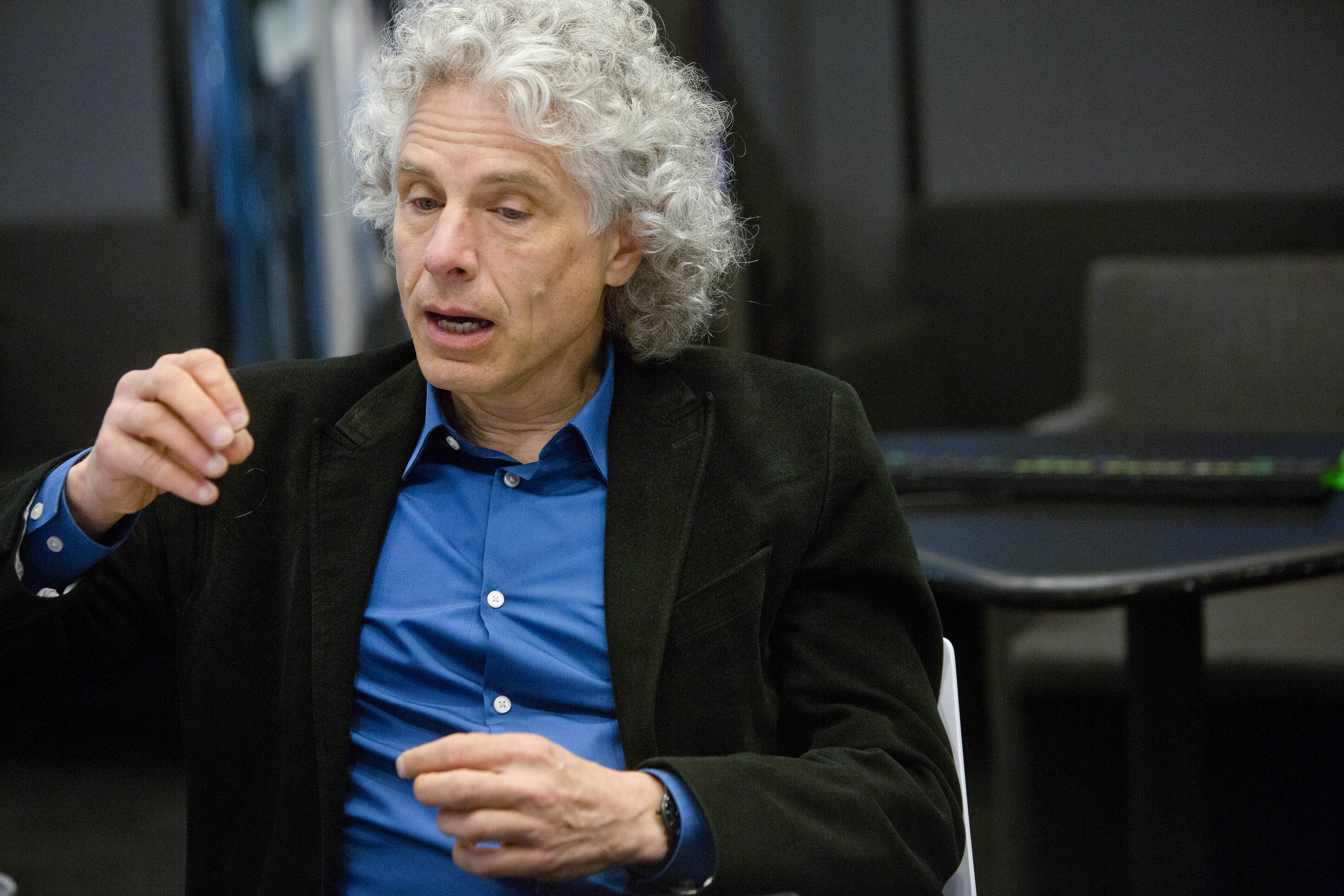
Harvard professor Steven Pinker on May 22, 2015.(Victor J. Blue/Bloomberg via Getty Images)
Several other international students spoke on the condition of anonymity to avoid threatening their student visa status. They described this moment at Harvard as a doubly difficult: Already under threat of losing their visas — like more than 1,800 international students and recent graduates reportedly have nationwide, prior to the administration’s reversal this week — they’re also at the school that Trump is most closely scrutinizing.
One international law student said she won’t walk near protests, has taken down her social media profiles or made them private and looked into finishing her degree abroad.She keeps emergency hotline numbers and her passport with her at all times in case she is approached.
“I have no disciplinary record. I have no criminal record. I have nothing. And I’m a good student,” she said. “And, sure, I care about things, but that’s why you come to law school.”
An international environmental studies studentsaid they now plan to leave the country once they finish their degree.
“I’m just trying to protect rivers and waterways and the environment,” they said, “and I don’t feel particularly wanted here.”
They regularly have to visit different states to conduct surveys but say they are now more fearful of travel.
“Just having the Harvard international student label on me,” they said, “it makes me a lot more anxious about being around airports or being around security.”
An undergraduate international student who attended last year’s Harvard encampment and got doxed for their pro-Palestinian activism said they moved off campus and stopped attending classes in person for two weeks, triggered by the detention of Tufts University graduate student Rumeysa Ozturk. They have canceled an academic trip to Europe and skipped out on iftars during Ramadan — communal meals where Muslims break their fast during the Islamic holy month — worried that ICE might target such gatherings.
“I don’t feel safe at all being around protests and voices, which actually kills me from the inside, because I want to go there, and I want to voice my opinion,” they said.
Though some students applauded Harvard’s stand against Trump, others have mixed feelings about the school’s response thus far.
Harvard didn’t respond to questions about these concerns. But Masoud, of the Harvard Kennedy School, said he thought those changes would have happened even if Trump hadn’t been elected.
“The university recognizes that there are certain changes that needed to be made, and will make those changes,” he said, “but it’s not going to surrender its independence or its First Amendment rights just because the Trump administration thinks that it needs to do more.”
During what has become a weekly “know your rights” webinar for international students and staff, hosted by a university-affiliated attorney and an administrator from Harvard’s International Office on Tuesday, nearly 400 questions were submitted, but only a handful were directly answered. One piece of blunt advice they gave international students: Speaking out right now on any topic is much riskier than it would be for American citizens — or even for students at other schools.
“We are under the microscope right now, and so we really don’t know how to advise people,” said Jason Corral, a staff attorney with the Harvard Representation Initiative, a legal clinic that provides pro bono support to Harvard. “Are people going to be more scrutinized because they’re Harvard students? It seems like it, given the letter that that we received and that we’re trying to respond to. It gives me pause to even recommend school-sanctioned trips.”
Irene Ameena, a third-year law student who is a member of the Law School’s Justice for Palestine group, said students are defending themselves by organizing trainings on how to respond to potential encounters with ICE, walking around campus in groups and only communicating on encrypted apps.
“There are really strong mutual aid networks that have formed over the past few weeks,” Ameena said, “to keep each other safe.”
Beyond concerns over international students and free speech, faculty say the federal funding cuts are putting their careers in jeopardy. Though Harvard boasts a stunning $53.2 billion endowment, much of that funding is earmarked for specific programs and purposes. That leaves schools that rely heavily on federal funding, like the T.H. Chan School of Public Health, more vulnerable.
At a town hall meeting last week, Andrea Baccarelli, the school’s dean, described a range of measures meant to help offset terminated grants — from halting new hires and reducing how many Ph.D. students are admitted to cutting back on printers and getting rid of desktop phones. Baccarelli and Stephanie Simon, the school’s spokeswoman, spoke about likely layoffs and said it will need to diversify its revenue going forward, according to three professors who attended but declined to be named because they didn’t want to speak for the school.
“School leadership is working with department chairs and administrative directors to identify strategic priorities and make sustainable budget cuts,” Simon said in a statement to NBC News. “Unfortunately, this will lead to layoffs. We are working to minimize the impact on our outstanding workforce while protecting the heart of our research and educational missions.”
Harvard Medical School leaders provided a similar forecast at a separate town hall, The Harvard Crimson reported. Harvard has issued over $1.1 billion in bonds in the past two months, hoping to shore up its finances as the battle with the government escalates.
Apart from the financial harm, those cuts have taken an emotional toll.
Brittany Charlton, a public health professor who leads the LGBTQ Health Center of Excellence, said after the National Institutes of Health canceled her grants in March, two members of her research team went on medical leave due to mental health issues stemming from the situation.
“Our funding could come back,” she said. “But even if it does, irreparable harm has been done.”
Ahead of Saturday’s game against the Athletics in West Sacramento, the Chicago White Sox have completed a crosstown trade to add to their infield depth.
According to the club, the White Sox have acquired third baseman Gage Workman from the Chicago Cubs in exchange for cash considerations. Workman was designated for assignment by the Cubs earlier this week.
In a corresponding move, the White Sox have designated infielder Nick Maton for assignment.
Workman appeared in nine games with the Cubs so far this season, going 3-for-14 with one double and one walk at the plate.
Now 25, Workman previously spent several years in the Detroit Tigers organization, hitting .280/.366/.476 at the Double-A level with the Erie SeaWolves in 2024.
Maton, an Illinois native, was 9-for-52 with two home runs in 23 games with the White Sox this season.
The White Sox will take on the Athletics at 3:05 p.m. local time Saturday, while the Cubs will host the Philadelphia Phillies at Wrigley Field at 1:20 p.m.
He says he’s on a path to cut several new trade deals in a few weeks — but has also suggested it’s “physically impossible” to hold all the needed meetings.
Trump has said he will simply set new tariff rates negotiated internally within the U.S. government over the next few weeks — although he already did that on his April 2 “Liberation Day,” which caused the world economy to shudder.
The Republican president says he’s actively negotiating with the Chinese government on tariffs — while the Chinese and U.S. Treasury Secretary Scott Bessent have said talks have yet to start.
What should one believe? The sure bet is that uncertainty will persist in ways that employers and consumers alike expect to damage the economy and that leave foreign leaders scratching their heads in bewilderment.
And the consequences of all this tariffs turmoil are enormous.
Trump placed tariffs totaling 145% on China, leading China to retaliate with tariffs of 125% on the U.S. — essentially triggering a trade war between the world’s two largest economies with the potential to bring on a recession.
Trump’s negotiating trade deals with himself
The president told Time magazine in an interview released Friday that 20%, 30% or 50% tariffs a year from now would be a “total victory,” even though a financial market panic led him to temporarily reduce his baseline import taxes to 10% for 90 days while talks take place.
“The deal is a deal that I choose,” Trump said in the interview. “What I’m doing is I will, at a certain point in the not too distant future, I will set a fair price of tariffs for different countries.”
If that is confusing for the nation’s trading partners, it’s also sowing anxiety at home.
The Federal Reserve’s beige book, a compilation of anecdotes from U.S. businesses prepared eight times a year, on Wednesday reported a huge spike in uncertainty among American companies that has caused them to pull back on hiring and investment in new projects. The word “uncertainty” cropped up 80 times, compared with 45 in early March and just 14 in January.
Beyond the idea that Trump plans to keep some level of tariffs in place, the world finance ministers and corporate executives who gathered this past week in Washington for the International Monetary Fund conference said in private discussions that the Trump administration was providing no real clarity on its goals for substantive talks.
“There’s not a coherent strategy at the moment on what the tariffs are supposed to achieve,” said Josh Lipsky, senior director of the GeoEconomics Center at The Atlantic Council. “My conversations with the ministers and governors this week at the IMF meetings have been they don’t understand completely what the White House wants, nor who they should be negotiating with.”
Other countries trying to get talks going
Swiss President Karin Keller-Sutter, in an interview with broadcaster SRF released Friday, said after a meeting with Bessent that Switzerland would be one of 15 countries with which the United States plans to conduct “privileged” negotiations. But she said a memorandum of understanding would have to be reached for talks to formally begin.
She was happy to at least know whom to talk to, saying that “we have also been assigned a specific contact person. This is not easy in the U.S. administration.”
Nations are deploying various negotiating tactics.
The South Korean officials who met with their U.S. counterparts this week say they specifically asked for the tariffs to be lifted with the goal of working toward an agreement by July. The European Union has pushed for cutting tariffs to zero for both parties, though Trump objects to European countries charging a value-added tax, which is akin to a sales tax that he says hurts U.S. goods.
Trump continues to radiate optimism that negotiated deals with other countries will occur despite his claims that he will set his own deals and a lack of clarity about how the process goes forward.
“I’m getting along very well with Japan,” Trump told reporters on Friday. “We’re very close to a deal.”
As part of a deal with Japan, the Trump administration has publicly called on the Japanese government to change its auto safety standards that put a greater focus on pedestrian safety. But the steering wheels on autos sold in Japan are on the right-hand side, while U.S. automakers put their steering wheels on the left.
“I don’t think left-hand drive cars sell in Japan,” Prime Minister Shigeru Ishiba told a parliamentary session this week.
“We want to make sure we aren’t seen as being unfair,” Ishiba said, suggesting a possibility of reviewing Japanese car safety standards.
Higher prices and shortages are likely
As Trump continues to make conflicting statements about tariffs, companies are actively looking at higher prices, lower sales and possibly bare shelves in stores due to fewer shipments from China.
Ryan Petersen, CEO of Flexport, a supply chain company, said on the social media site X: “In the 3 weeks since the tariffs took effect, ocean container bookings from China to the United States are down over 60% industry wide.”
Consumers are getting notices via email and social media from retailers that lamps, furniture and other housewares will now include tariff-related charges.
The showerhead company Afina on Wednesday reported on a test to see if people would buy an American-made product that cost more than an import. Their Chinese-made filtered showerhead retails for $129, but to manufacture the same product domestically would take the price up to $239.
When customers on the company’s website were given a choice between a showerhead made in the USA or a cheaper one made in Asia, there were 584 purchases of the $129 model made abroad and not one sale of the domestically produced showerhead.
Ramon van Meer, Afina’s founder, concluded in his written analysis: “If policymakers and pundits want to rebuild American industry, they need to grapple with this truth: idealism doesn’t always survive contact with a price tag.”
___
AP economics writer Christopher Rugaber in Washington and AP writers Jamey Keaten in Geneva and Mari Yamaguchi in Tokyo contributed to this report.